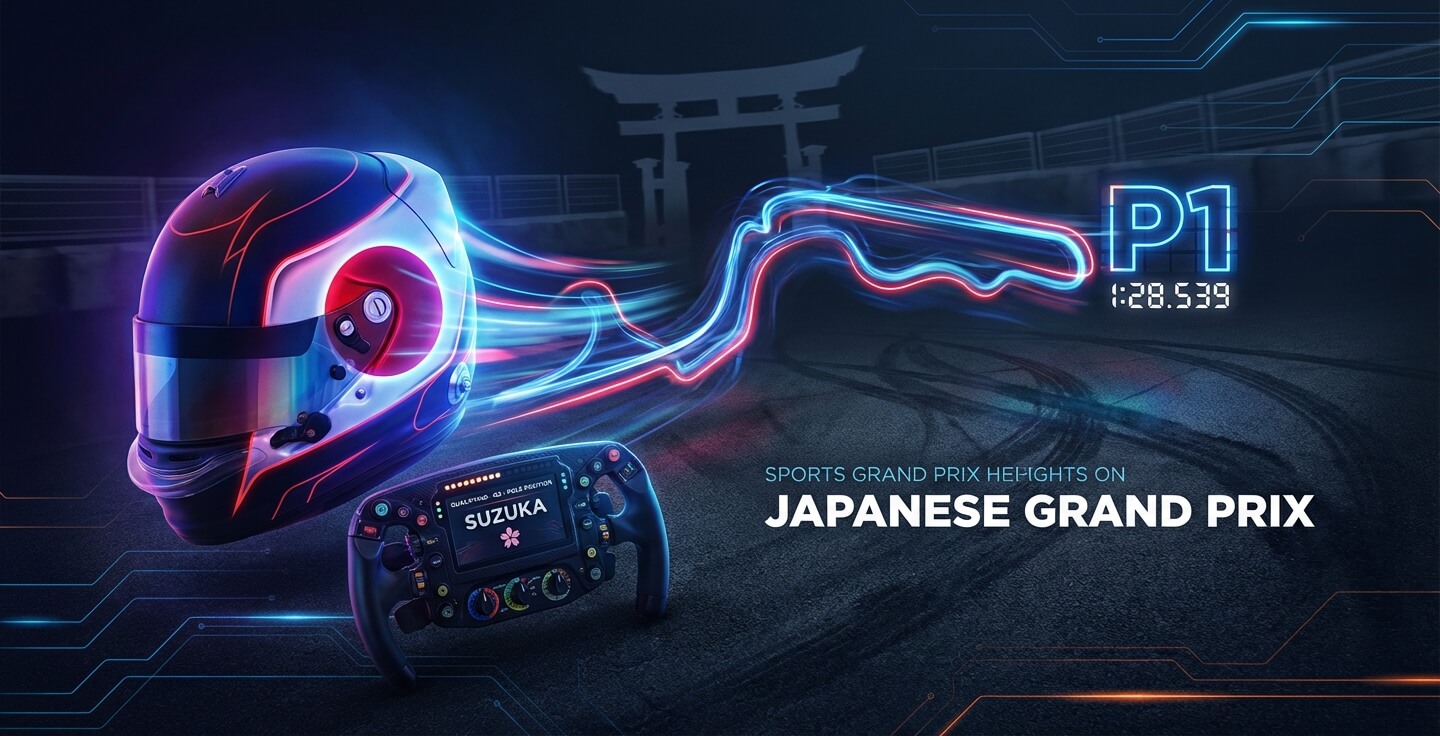
Japanese Grand Prix: Mastering Suzuka's Pole Position
The Japanese Grand Prix at the iconic Suzuka Circuit is a cornerstone of the Formula 1 calendar, renowned for its challenging layout and passionate fans. Securing pole position here is more than just starting at the front; it's a profound statement of a driver's skill and a team's engineering prowess. This detailed guide explores the history, strategy, and sheer exhilaration behind achieving the coveted pole at one of motorsport's most respected venues, giving you an insider's view on what it takes to conquer Suzuka's legendary asphalt.
The Unique Challenge of Suzuka for Pole Position
Suzuka is not just any racetrack; it's a legendary figure-eight circuit that demands absolute precision, courage, and a perfectly balanced car. Its unique crossover layout, the only one in Formula 1, presents a dynamic challenge for drivers aiming for the fastest qualifying lap. From the high-speed, flowing "Esses" section to the daunting 130R corner and the technical Spoon Curve, every meter of Suzuka tests the limits of both man and machine. Unlike circuits that might favor raw engine power or aerodynamic downforce exclusively, Suzuka requires a harmonious blend of both.
Achieving pole position here means a driver has perfectly navigated the circuit's undulating nature, mastering its fast transitions and critical braking zones. The narrow track width in certain areas, combined with a unforgiving lack of run-off zones, means that any minor error in qualifying can cost precious tenths of a second or, worse, result in a crash. For you, the fan, witnessing a perfect pole lap at Suzuka is to see a driver operating at the absolute peak of their abilities, demonstrating control and aggression in equal measure.
The Esses, a sequence of high-speed bends, are particularly crucial for a quick lap time. Here, drivers must carry immense speed through multiple apexes with minimal steering input, relying heavily on the car's aerodynamic grip. A slight twitch or an incorrect entry speed can compromise the entire sequence, making it incredibly difficult to recover time later in the lap. Furthermore, the final sector, featuring the Spoon Curve and the flat-out 130R before the chicane, demands bravery and supreme confidence in the car's setup. A car that is stable under high-speed load and responsive through quick changes of direction is paramount for pole at Suzuka.
Historical Dominance: Drivers with the Most Poles at Suzuka
Over its rich history, the Japanese Grand Prix at Suzuka has been graced by some of the sport's most legendary drivers, many of whom have carved out a special relationship with its demanding qualifying challenges. Securing multiple pole positions at Suzuka is a testament to sustained excellence and an unparalleled understanding of the circuit's nuances. These drivers didn't just have fast cars; they possessed an innate ability to extract every ounce of performance during the critical qualifying session, often under immense pressure.
Looking back, certain names repeatedly appear at the top of the pole position charts, signaling their mastery of Suzuka's unique characteristics. For you, understanding who these legends are provides context to the circuit's enduring legacy and highlights the caliber of talent required to truly dominate here. It's a blend of raw speed, technical precision, and mental fortitude that sets these drivers apart, enabling them to consistently outpace their rivals.
Here’s a look at the drivers who have achieved the most pole positions at the Japanese Grand Prix:
| Driver | Number of Poles | Years Achieved |
|---|---|---|
| Michael Schumacher | 8 | 1994, 1995, 1996, 1997, 1999, 2000, 2001, 2002 |
| Lewis Hamilton | 4 | 2007, 2017, 2018, 2019 |
| Sebastian Vettel | 5 | 2009, 2010, 2011, 2012, 2013 |
| Ayrton Senna | 3 | 1988, 1989, 1993 |
| Alain Prost | 2 | 1987, 1990 |
| Fernando Alonso | 2 | 2006, 2012 |
| Max Verstappen | 3 | 2022, 2023, 2024 |
Michael Schumacher's eight poles stand as a monumental achievement, reflecting his unparalleled focus and ability to extract the maximum from his Ferrari cars during their dominant era. His precision and aggressive driving style perfectly suited Suzuka's demands. More recently, Sebastian Vettel's five poles during Red Bull's golden years showcased his exceptional qualifying pace, especially his ability to string together perfect sectors. Lewis Hamilton has also demonstrated formidable speed, with his poles often coming during Mercedes' hybrid-era dominance. Watching these drivers push the limits on a qualifying lap at Suzuka is truly a masterclass in motorsport.
Constructors' Supremacy: Teams on Pole at the Japanese GP
While individual driver skill is paramount, the role of the constructor in securing pole position at Suzuka cannot be overstated. A perfectly engineered car, tailored to the unique demands of this high-speed, high-downforce circuit, provides the foundation upon which a driver can build a pole-winning lap. Teams invest countless hours in simulations, wind tunnel testing, and component development to create a machine capable of mastering Suzuka's specific challenges, from its fast sweeps to its technical braking zones.
Historically, certain constructors have consistently demonstrated an advantage in qualifying at the Japanese Grand Prix, often reflecting periods of overall dominance in the sport. These teams possess a deep understanding of aerodynamics, suspension setup, and power unit integration crucial for Suzuka. For you, recognizing these patterns helps to understand the intricate relationship between car design, team strategy, and on-track performance during qualifying sessions.
Here’s a look at the constructors with the most pole positions at the Japanese Grand Prix:
| Constructor | Number of Poles | First Pole | Last Pole |
|---|---|---|---|
| Ferrari | 11 | 1994 | 2019 |
| McLaren | 10 | 1987 | 2012 |
| Red Bull Racing | 8 | 2009 | 2024 |
| Mercedes | 6 | 2014 | 2018 |
| Williams | 3 | 1992 | 1996 |
| Renault | 1 | 2006 | 2006 |
Ferrari and McLaren have historically dominated the pole positions at Suzuka, often reflecting their periods of F1 supremacy. Ferrari's strong record is heavily influenced by Michael Schumacher's era, showcasing their ability to build cars that were both powerful and incredibly balanced. McLaren, with drivers like Senna and Prost, also had a formidable record, particularly in the late 1980s and early 1990s. In the modern era, Red Bull Racing and Mercedes have emerged as the leading forces, demonstrating exceptional aerodynamic efficiency and power unit integration that allows their drivers to extract maximum performance during qualifying. Red Bull's recent string of poles underscores their current technical advantage at circuits that reward precise aerodynamic design. The synergy between a world-class driver and a perfectly optimized car is what ultimately leads to pole position glory at Suzuka.
The Correlation Between Pole Position and Race Victory
Compare Best Odds →Securing pole position at Suzuka is undoubtedly a massive advantage, but how often does it translate into a race win? While starting from the front is statistically the best place to be on any grid, Suzuka's challenging nature and strategic complexity mean that pole position isn't always a guaranteed path to victory. However, it certainly offers a significant statistical edge, providing the pole-sitter with clear air, the preferred line into Turn 1, and the ability to dictate race pace from the outset.
Historically, a significant percentage of Japanese Grand Prix winners have started from pole position. This is largely due to Suzuka being a track where overtaking, while possible, is not straightforward. The high-speed nature of many corners means that following another car closely can lead to significant aerodynamic turbulence, making it difficult to mount a sustained attack. Therefore, the ability to control the race from the front is often decisive. For you, understanding this dynamic highlights why qualifying is so critical at Suzuka.
However, there are always factors that can disrupt this correlation. Weather conditions, particularly the unpredictable rain that can sweep across Suzuka, can dramatically shake up the race, negating any grid advantage. Safety Car periods, often triggered by incidents on such a demanding track, can also compress the field and open up strategic opportunities for cars starting further back. Tire degradation rates, pit stop strategies, and even slight driver errors can all play a role in whether pole position converts to a race victory.
Despite these variables, the statistics firmly support the notion that pole position is crucial at Suzuka. Over 60% of Japanese Grand Prix winners at Suzuka have started from pole position. This high conversion rate emphasizes the importance of a clean start, effective tire management, and maintaining a relentless pace throughout the race. It's a testament to the fact that while Suzuka offers challenges, starting from the front gives you the best possible platform to overcome them and stand on the top step of the podium.
Modern Era Pole-Sitters and Their Strategies
The modern era of Formula 1 has seen a blend of established champions and rising stars battling for pole position at Suzuka, each employing sophisticated strategies to shave off those crucial milliseconds. Drivers like Max Verstappen, Lewis Hamilton, and Charles Leclerc have delivered breathtaking qualifying laps, showcasing the peak of contemporary F1 performance. Their approaches combine advanced telemetry data, extensive simulator work, and an almost intuitive feel for the limits of their high-tech machines.
In today's Formula 1, qualifying is a meticulously planned affair. Teams analyze every sector, every braking point, and every corner exit from practice sessions, feeding this data back to the driver. The choice of tire compounds is also critical; generally, the softest available tire is used in Q3 to extract maximum grip for a single flying lap. However, managing these tires for optimum performance over one lap, while also ensuring they are ready for the subsequent race, is a delicate balance.
Modern pole-sitters at Suzuka often demonstrate an incredible ability to link together multiple perfect mini-sectors. Max Verstappen, for instance, has shown a remarkable talent for being quick through Suzuka's fast, flowing sections while maintaining precision in the more technical parts. Lewis Hamilton's pole laps have often been characterized by his aggressive yet smooth style, extracting every ounce of performance from the Mercedes package. Charles Leclerc, known for his raw speed, attacks Suzuka with fearless commitment, particularly in the high-speed Esses.
Furthermore, the role of "tow" or slipstream has become a more nuanced consideration. While beneficial on long straights, Suzuka's configuration means a perfectly executed solo lap is often preferred, as a slight misjudgment with a tow partner can disrupt a driver's rhythm. The qualifying format, with its three distinct sessions (Q1, Q2, Q3), also influences strategy, as teams aim to progress with the minimum number of laps while preserving tires and engine mileage. Ultimately, a modern pole position at Suzuka is a perfect storm of driver talent, advanced engineering, and strategic brilliance.
Key Factors for Securing Pole Position at Suzuka
To truly understand what it takes to achieve pole position at the Japanese Grand Prix, you must delve into the multifaceted elements that converge to create that perfect qualifying lap. It's never just one factor but a harmonious integration of driver, car, and conditions. Here, we break down the critical components:
Driver Skill and Precision
At Suzuka, driver skill is arguably the most crucial element. The circuit demands a unique blend of bravery and finesse. Drivers must commit to high-speed corners like the Esses and 130R with unwavering confidence, pushing the car to its absolute limits of grip. Precision is key in placing the car perfectly for each apex, especially in the continuous flow of corners where a slight error in one turn compromises the next. Smooth inputs, quick reflexes, and an exceptional understanding of tire grip are paramount. Legendary pole-sitters like Michael Schumacher and Ayrton Senna demonstrated an almost telepathic connection with their cars, able to dance on the edge of adhesion lap after lap. For you, it's the artistry of the driver making the car sing that creates a pole lap at Suzuka.
Car Setup and Aerodynamics
A perfectly balanced car setup is non-negotiable for pole at Suzuka. Given the circuit's blend of high-speed sections and technical corners, teams must strike a delicate balance between maximum downforce for grip and minimal drag for straight-line speed. Aerodynamic efficiency is particularly critical through the Esses and 130R, where stable high-speed performance is vital. Engineers work tirelessly to optimize wing angles, suspension settings, and ride height to ensure the car is responsive and predictable. The unique figure-eight layout also presents challenges in finding a symmetrical setup that works across both left and right-hand corners. A car that inspires confidence in the driver, allowing them to push aggressively through Suzuka’s demanding sectors, is essential for a pole-worthy performance.
Tire Management and Strategy
Pirelli's tire compounds play a significant role in qualifying performance. In Q3, drivers typically use the softest available compound to maximize grip for their flying lap. However, simply bolting on new soft tires isn't enough. Tire warm-up procedures, out-lap management, and understanding the tire's peak performance window are critical. An optimal out-lap ensures the tires are at their ideal operating temperature for the start of the flying lap, providing maximum grip without overheating. Over-pushing on the out-lap can lead to degradation before the timed lap even begins, while being too conservative might mean the tires aren't fully up to temperature. Teams and drivers meticulously plan their tire usage across all qualifying sessions to ensure they have fresh, optimally conditioned soft tires for when it truly matters.
Weather Conditions
Suzuka is notorious for its unpredictable weather, and rain can drastically alter the qualifying landscape. Wet weather introduces an entirely different set of challenges, demanding exceptional car control and adaptability from drivers. The grip levels change moment by moment, and the potential for aquaplaning adds another layer of risk. Teams must make rapid decisions on tire choice (intermediate or full wet) and car setup adjustments. In such conditions, driver talent often shines even brighter, as the ability to find grip on a treacherous surface can separate the contenders from the rest. A driver who is comfortable and confident in the rain can often surprise, delivering a pole position that might have been out of reach in dry conditions. For you, a wet qualifying session at Suzuka is often one of the most thrilling spectacles in F1.
Future Prospects: Who Will Be the Next Pole King at Suzuka?
As Formula 1 continues to evolve, so too does the battle for pole position at the Japanese Grand Prix. With new generations of talent emerging and technical regulations shifting, the question of who will be the next dominant force in Suzuka qualifying remains an exciting one. Current stars and upcoming prodigies are all vying to etch their names into the circuit's illustrious history, showcasing their potential to become the next pole king.
Max Verstappen, having already secured multiple poles at Suzuka, is a strong contender to extend his dominance. His aggressive yet precise driving style perfectly suits the circuit, and with Red Bull's continued engineering prowess, he is well-placed to challenge Michael Schumacher's record of eight poles. His consistent ability to extract maximum performance from the car on a single lap makes him a formidable opponent in qualifying.
Other drivers to watch include Charles Leclerc, whose raw speed and fearless approach could see him add more Suzuka poles to his tally. His ability to push the limits, especially in the high-speed sections, makes him a constant threat. Similarly, Lando Norris has demonstrated exceptional qualifying pace and maturity, and as McLaren continues to develop, he could very well challenge for pole positions at tracks that favor driver skill, like Suzuka. Keep an eye on George Russell as well; with Mercedes pushing for a return to championship contention, his consistent qualifying performances could translate into Suzuka poles.
Beyond the established names, the future of Formula 1 promises exciting new talents. As young drivers enter the sport, they bring fresh perspectives and an eagerness to prove themselves. The unique challenge of Suzuka will undoubtedly be a benchmark for these rising stars. For you, watching these battles unfold adds another layer of excitement to the Japanese Grand Prix, anticipating who will rise to the occasion and master Suzuka's qualifying test in the years to come. The hunt for pole position will always be a highlight, symbolizing ultimate speed and control.
Frequently Asked Questions About Japanese Grand Prix Pole Position
What is the fastest-ever pole lap at the Japanese Grand Prix?
The fastest-ever pole lap at the Suzuka Circuit was set by Lewis Hamilton in 2017, driving for Mercedes. He clocked an astonishing 1:27.319. This lap showcased the incredible speed of the hybrid-era cars combined with Hamilton's exceptional driving skill, breaking Michael Schumacher's long-standing track record.
Has anyone won the Japanese Grand Prix from outside the front row?
Yes, while starting from pole or the front row is a significant advantage, drivers have indeed won the Japanese Grand Prix from further down the grid at Suzuka. A notable example is Kimi Räikkönen in 2005, who started 17th due to a grid penalty and famously charged through the field to win on the final lap. This highlights that while pole is vital, strategic brilliance, favorable weather, or exceptional race pace can sometimes overcome a starting disadvantage.
Which driver holds the record for the most consecutive poles at Suzuka?
Michael Schumacher holds the record for the most consecutive pole positions at the Suzuka Circuit, achieving five consecutive poles from 1999 to 2003. This remarkable streak underscores his dominance during that period and his unparalleled consistency in mastering the challenging Japanese track during qualifying.
How much advantage does pole position offer at Suzuka?
Pole position at Suzuka offers a considerable advantage, significantly increasing a driver's chances of winning the race. Historically, over 60% of Japanese Grand Prix winners at Suzuka have started from pole position. The tight, high-speed nature of the track makes overtaking challenging, giving the pole-sitter clear air into Turn 1 and the ability to control the race from the front without having to contend with aerodynamic turbulence from other cars.
What makes Suzuka such a challenging track for qualifying?
Suzuka's challenging nature for qualifying stems from its unique figure-eight layout, high-speed corners, and technical demands. The Esses demand perfect rhythm and minimal steering inputs at immense speed, while the fearsome 130R and precise Spoon Curve test a car's aerodynamic stability and a driver's courage. There's little room for error; a slight mistake can compromise an entire sector or even lead to a costly incident. It requires a perfect blend of car balance, driver precision, and aggressive commitment.
Conclusion: The Enduring Allure of Suzuka Pole
See Our Top Pick →The pursuit of pole position at the Japanese Grand Prix is a narrative steeped in motorsport lore, representing the pinnacle of speed, precision, and courage. From the historic dominance of legends like Schumacher and Senna to the modern-day brilliance of Verstappen and Hamilton, securing pole at Suzuka is a profound statement of intent. It signifies a perfect harmony between driver and machine, meticulously tuned to conquer one of Formula 1's most demanding circuits. For you, the fan, it offers a glimpse into the very essence of F1: raw speed, strategic genius, and breathtaking skill. As the Japanese Grand Prix continues to captivate audiences, the quest for that ultimate qualifying lap will forever remain a thrilling and defining moment of the season.